Saving
Cash ISA allowances are changing.
By Charlotte Lorimer
Saving

When it comes to growing your savings, there’s a formula you can use to your advantage: compound interest.
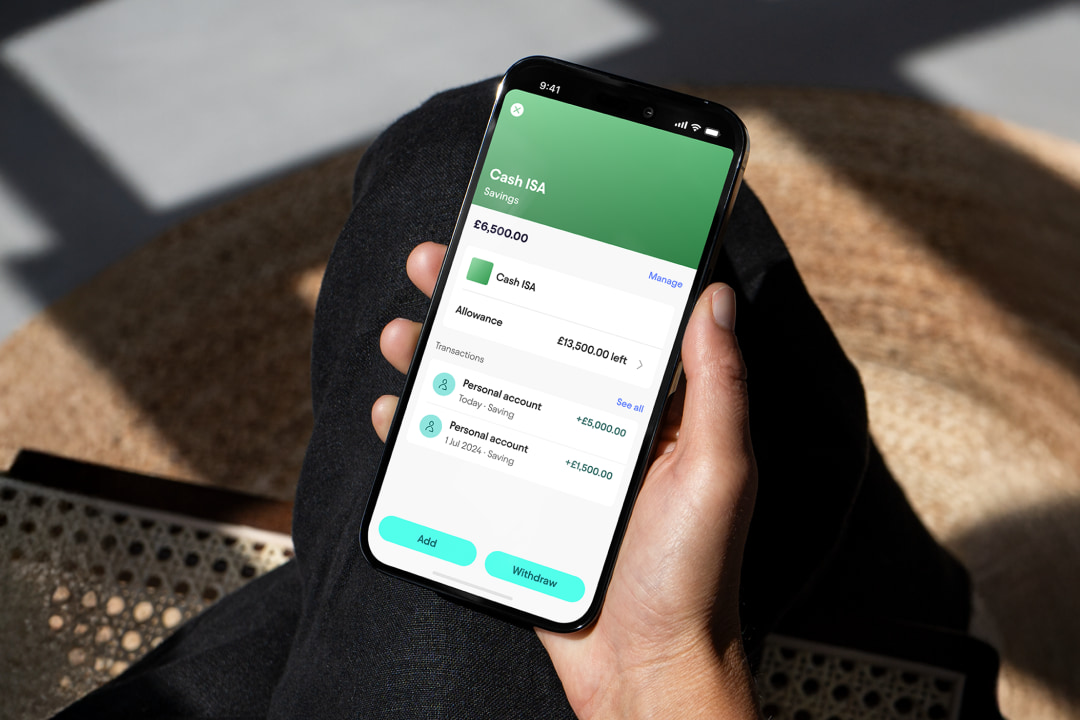
Essentially, it’s ‘interest on interest’. Say you set £10,000 aside in Starling’s Cash ISA, which has an interest rate of 2.50% AER (2.46% tax-free)*. For our ISA, we calculate interest daily and pay it monthly, which means your money ‘snowballs’.
Just like a snowball rolling down a hill, picking up momentum and growing over time, your original sum increases – without any additional effort from you. How? Because you earn interest both on your original £10,000 and on the interest you’ve earned since setting your £10,000 aside.
Compound interest and simple interest use different formulas. Compound interest is calculated on an initial deposit (known as the principal) and any interest that’s accumulated since the deposit was made.
Simple interest is only calculated on the principal – no ‘interest on interest’.
Here’s what the difference could look like for your money:
| Interest rate: 2.50% AER (2.46% tax-free) Initial deposit: £10,000 | Balance if interest is earned and added monthly – compound interest | Balance if interest is earned and added annually – compound interest | Balance if interest is earned annually, then removed – simple interest |
|---|---|---|---|
| Year 1 | £10,252.88 | £10,250.00 | £10,250.00 |
| Year 2 | £10,512.16 | £10,506.25 | £10,250.00 |
| Year 3 | £10,778.00 | £10,768.91 | £10,250.00 |
| Year 4 | £11,050.56 | £11,038.13 | £10,250.00 |
| Year 5 | £11,330.01 | £11,314.08 | £10,250.00 |
In the table above, we’ve assumed that no extra money is added after the initial deposit has been made. For the account where interest is paid annually, we’ve assumed that the interest earned is taken out each year and therefore does not compound either monthly, or annually.
Tip: If interest is calculated and added daily or monthly (compound interest), your savings will grow more quickly than if interest is calculated annually and only on the original sum (simple interest), as shown in the table above.
To calculate compound interest, you need three key things:
The initial deposit or ‘principal’, let’s call this ‘P’
The interest rate as a decimal, shown as ‘r’
The number of times interest compounds per year, shortened to ‘n’
And the number of years the deposit is saved, shown as ‘t’
The formula or equation to work out your initial deposit plus interest is:
A=P(1+(r/n))ⁿᵗ
But you may find it easier to use a compound interest calculator. These allow you to add the key information and see a calculation for your savings or debt after a certain number of years.
We offer three types of accounts that pay interest:
Cash ISA (2.50% AER/ 2.46% tax-free variable)
Easy Saver (5.00% AER/ 4.87% gross variable on balances up to £25k with our personal Easy Saver. Includes a fixed bonus of 2.50% AER for your first 6 months. New customers only.)
Fixed Saver (4.20% AER/gross)
With our Cash ISA and Easy Saver, interest is calculated daily and paid monthly – so the interest compounds each day. With the Fixed Saver, interest is only calculated on the original deposit and then paid after a twelve month period, so is an example of simple interest.
*’AER’ stands for Annual Equivalent Rate and illustrates what the interest rate would be if interest was paid and compounded once each year. Any tax benefit you receive from an ISA depends on your individual circumstances and may change in the future.
**The article above includes general information and should not be taken as financial advice. If you have questions about your specific circumstances, please speak to an independent financial advisor.
Article updated: 1 October 2026
Keen to earn interest tax-free? And let it compound?
Learn more about our flexible Cash ISA